Module 1

🧠 Artificial Intelligence β€” Real-Time Tactical Threat Analysis

Core Advantage: SirenUA executes real-time neural threat classification with dynamic rule injection against 5 high-speed intelligence streams. Ingestion-to-alert latency averages under 3 seconds.

Dynamic Rule Injection Engine

Prior to executing each classification prompt, the inference engine ranks and dynamically selects the 6–8 most accurate empirical rules from the knowledge base. Rules are evaluated based on historical precision and confirmation frequency.

Priority Multipliers: Direct mentions of specific administrative centers (Kyiv, Kharkiv, Odesa, Dnipro, Lviv) or weapon classes (ballistics, Shahed drone, glide bomb) trigger higher weighting. Launch site correlation heuristics receive top priority for rapid regional classification.

20 Canonical Threat Categories

Every aerial track is mapped into one of 20 standardized categories with custom kinematic models:

Icon Threat Classification Kinematic Speed Active Lifetime
πŸ›΅Shahed-136 Loitering Munition185 km/hup to 3 hours
πŸ”₯Jet-Powered Attack UAV500 km/h1.5 hours
πŸš€Subsonic Cruise Missile (Kalibr / Kh-101)850 km/h45 minutes
πŸ’₯Quasi-Ballistic Missile (Iskander-M / KN-23)5,500 km/h10 minutes
⚑Kh-47M2 Kinzhal Aeroballistic Missile2,500 km/h30 minutes
πŸ’£Guided Aerial Bomb (KAB / FAB with UMPK)900 km/h5 minutes
✈️Tu-95MS Strategic Missile Carrier800 km/h1.5 hours
πŸ›©οΈTu-22M3 Long-Range Bomber (Kh-22/32)4,200 km/h1 hour
🎯Tactical Strike Fighter (Su-34 / Su-35)950 km/h45 minutes
πŸ”₯Iskander Operational Tactical Launcher5,500 km/h20 minutes
πŸ’’Multiple Launch Rocket System / Artillery1,200 km/h30 minutes
⚠️Chemical Contamination Alertβ€”2 hours
☒️Radiological Emergency Alertβ€”2 hours
πŸ”₯Hypersonic 3M22 Zircon Missile11,000 km/h10 minutes
πŸ’₯Heavy MLRS (Tornado-S / Smerch)2,200 km/h20 minutes
🎯Tactical FPV Drone / Lancet140 km/h30 minutes
πŸ‘οΈReconnaissance Drone (Orlan / Zala / Supercam)120 km/h1 hour
πŸ””Official General Air Raid Alertβ€”1 hour

Post-Attack Autonomous Reflection

Upon the conclusion of an attack wave, the system triggers a post-mortem review: comparing initial OSINT alerts, tactical vectors, air defense interceptions, and event lifespans. The AI autonomously generates 1–3 calibrated empirical rules to refine subsequent classification accuracy.

6-Hour Statistical Learning Loop

Every 6 hours, background statistical jobs analyze the past 30 days of data across 7 mathematical validation criteria:

  1. Route Vector Patterns β€” Mapping recurring transit corridors across regions
  2. Confidence Calibration β€” Adjusting sensitivity thresholds in low-density sectors
  3. Temporal Clustering β€” Identifying peak hours for recurring drone launches
  4. Flight ETA Calculations β€” Refining flight duration math for specific corridors
  5. Airbase Correlation β€” Tracking takeoffs from Olenya, Engels-2, and Savasleyka
  6. Launch Hub Fingerprinting β€” Primorsko-Akhtarsk, Chauda, and Caspian launch sectors
  7. Rule Decay & Pruning β€” Deactivating heuristics with dropping accuracy
Module 2

πŸ›°οΈ Palantir-Grade Multi-Domain Sensor Fusion Architecture

Defense-Grade Paradigm: SirenUA operates on an autonomous sensor fusion layer comparable to military systems like Palantir AIP and Foundry. Rather than relying on a single telemetry point, our pipeline continuously integrates 5 heterogeneous data streams into a unified Common Operating Picture (COP).

4 Multispectral Ingestion Channels

Every incoming signal is timestamped with sub-millisecond precision, deduplicated, and passed through dynamic noise filters:

Autonomous Multi-Agent Neural Mesh

Our server architecture coordinates 4 dedicated sub-agents in parallel:

  • KinematicsPredictor β€” Computes ballistic parabola curves, structural G-forces, and interception debris dispersion radius.
  • TerrainMaskingEngine β€” Correlates target flight altitudes against 3D Digital Elevation Models (DEM) to pinpoint blind radar sectors.
  • DeceptionClassifier β€” Isolates decoy drones (Gerbera/Parodiya) without warheads using mass-to-velocity radar returns.
  • EvacuationOptimizer β€” Dynamically generates turn-by-turn routing to verified Tier 1–4 civil defense shelters.

Module 3

πŸ—ΊοΈ Tactical Map β€” Zero-Flicker Vector Rendering

Core Advantage: Fullscreen live map supporting all 27 regions with smoothed BΓ©zier flight curves, launch markers, and optimized state diffing for 0% idle CPU overhead.

27 Regional Polygons

Every administrative region is color-coded based on live threat telemetry. Boundary polygons are decoded in background threads and cached locally to ensure fluid 60/120 FPS panning on iOS devices.

Smoothed BΓ©zier Trajectories

Flight paths are rendered as smooth curvature vectors using mathematical smoothing algorithms:

  • Solid Vector Lines β€” Active confirmed flight path from launch/detection point to target sector
  • Dashed Carrier Ingress β€” Aircraft flight path from base to designated missile launch Ρ€ΡƒΠ±Π΅ΠΆ
  • Flow Chevrons β€” Dynamic heading arrows showing immediate flight direction
  • Pulsing Node Markers β€” Latest confirmed telemetry coordinates

Module 3

πŸ›‘οΈ Civil Defense Shelter Engine β€” 3-Stage Cascading Search

Core Advantage: Immediate routing to the nearest verified bunker. Pre-seeded with 26 regional civil defense databases ensuring zero cold-start latency even under degraded network conditions.

3-Stage Cascading Search Architecture

  1. Stage 1: Pre-Seeded Civil Defense Registry β€” Verified bomb shelters, subway stations, specialized basements in schools, hospitals, and administrative centers loaded instantly from local storage.
  2. Stage 2: Spatial OpenStreetMap Verification β€” Regular background updates filtering out non-shelter structures such as bus stops or kiosks.
  3. Stage 3: Targeted Live Proximity Query β€” Rapid radial search to identify underground parking structures and newly designated safe spaces.

Safety Tier Classification


Module 4

πŸ“Š Tactical Corridor Modeling & Geospatial Intelligence

Core Advantage: Probabilistic route chain modeling that anticipates likely target regions, evaluates air defense interception zones, and tracks enemy launch infrastructure.

Probabilistic Multi-Hop Route Chains

By analyzing the spatial history of past attacks, the system models transition probabilities between adjacent regions. When incoming targets reach key navigational checkpoints, neighboring sectors are warned in advance.

Air Defense Density Mapping

Analysis of defensive coverage enables accurate estimation of interception points and likely flight path deviations.


Module 5

πŸ”” Intelligent Critical Alert Delivery

Core Advantage: 4 distinct alert sounds, 7 independent configuration toggles, guaranteed Critical Alert delivery through Do Not Disturb, and batch debouncing during mass attack waves.

4 Distinct Alert Channels

Granular District Filtering

Users can subscribe to specific administrative districts inside large regions to avoid alert fatigue caused by distant events.

Module 6

🎯 20 Threat Types β€” Physics-Based Ballistic Profiles

Complete Tactical Spectrum: SirenUA incorporates physics and kinematic models for 20 distinct aerial hazard classes β€” ranging from slow-flying loitering munitions to Mach-10 hypersonic aero-ballistic missiles.

πŸš€ Subsonic Cruise Missiles (LACM)

Kh-101 / Kh-555 / Kalibr / Iskander-K

Speed: 720–900 km/h (Mach 0.7–0.85)

Altitude: 30–120 meters terrain-following radar avoidance

AI Detection: Dynamic waypoint detection, programmable loops, and riverbed corridor tracking.

View Threat Matrix→
πŸ’₯ Quasi-Ballistic Missiles (SRBM)

Iskander-M (9M723) / KN-23

Speed: 2,100–5,500 km/h (up to Mach 5.5)

Altitude: High-altitude quasi-ballistic arc up to 50 km

AI Detection: Instant launch point identification and impact zone sector computation under 40 seconds.

View Threat Matrix→
⚑ Hypersonic & Aero-Ballistic

Kh-47M2 Kinzhal / 3M22 Zircon

Speed: 7,000–11,000 km/h (up to Mach 10)

Flight Time: 2–6 minutes to any point in Ukraine

AI Detection: Airborne radar detection of MiG-31K sorties from Savasleyka/Mozdok airbases.

View Threat Matrix→
πŸ›Έ Loitering Munitions & Decoys

Shahed-136 / Geran-2 / Gerbera

Speed: 150–220 km/h

Endurance: 4–6 hours loitering time

AI Detection: Swarm clustering, acoustic signature verification, and decoy separation.

View Threat Matrix→
πŸ’£ Guided Aerial Bombs (KAB)

FAB-250/500/1500 with UMPK Kit

Glide Speed: 800–1,000 km/h

Standoff Range: 45–80 km from frontline

AI Detection: Tracking Su-34 tactical loft maneuvers and instantaneous border alerts.

View Threat Matrix→
✈️ Strategic Bombers

Tu-95MS / Tu-22M3 / Tu-160

Launch Hubs: Caspian Sea, Engels, Olenya, Mozdok

AI Detection: Flight time calculation from launch sectors to missile impact zones.

View Threat Matrix→

Full Catalog of 20 Threat Classes

Every aerial threat is classified using an individual physics and ballistics profile to calculate precise flight arrival times and civil defense protocols:

πŸ›΅
CLASS #01
Shahed-136 / Geran-2
Long-range loitering munition with acoustic engine signature tracking and riverbed masking.
πŸš€
CLASS #02
Kh-101 / Kh-555
Air-launched strategic cruise missile with terrain-contour following and in-flight waypoint maneuvers.
🌊
CLASS #03
3M-54 Kalibr
Sea-launched cruise missile deployed from submarines and surface corvettes in the Black/Caspian seas.
πŸ’₯
CLASS #04
9M723 Iskander-M
Quasi-ballistic solid-propellant missile with extreme terminal dive velocity and sub-3-minute arrival.
⚑
CLASS #05
Kh-47M2 Kinzhal
Air-launched aero-ballistic system carried by MiG-31K jets with high-altitude hypersonic acceleration.
πŸ’£
CLASS #06
Guided Bomb (KAB/UMPK)
Modular glide bombs (FAB-250/500/1500) released from tactical aircraft at altitudes up to 12 km.
✈️
CLASS #07
Tu-95MS Strategic Bear
Turboprop strategic missile platform (launch lines: Caspian Sea, Engels, Volgodonsk).
πŸ›©οΈ
CLASS #08
Tu-22M3 (Kh-22/32)
Supersonic maritime strike bomber armed with heavy supersonic anti-ship and land-attack missiles.
πŸ”₯
CLASS #09
3M22 Zircon
Scramjet-powered hypersonic anti-ship/land-attack cruise missile launched from coastal systems in Crimea.
🎯
CLASS #10
9M728 Iskander-K
Ground-launched tactical cruise missile traveling at low altitudes to bypass radar detection horizons.
πŸ›Έ
CLASS #11
Gerbera Decoy Drone
Unarmed foam decoy with radar reflectors designed to saturate air defense radars and deplete interceptors.
🏹
CLASS #12
Kh-31P / Kh-58
High-speed tactical anti-radiation missile homing in on air defense radar emissions.
🌊
CLASS #13
P-800 Oniks
Supersonic coastal defense cruise missile fired from Bastion-P launchers in occupied Crimea.
πŸ’₯
CLASS #14
S-300 / S-400 (Surface)
Repurposed anti-aircraft missiles fired on ballistic surface-to-surface trajectories at frontline cities.
πŸ’’
CLASS #15
Smerch / Tornado-S MLRS
Heavy 300mm multiple launch rocket systems dispersing cluster and fragmentation warheads.
🎯
CLASS #16
Su-34 / Su-35 Tactical Jets
Frontline strike aircraft performing glide bomb releases and tactical standoff missile launches.
πŸ‘οΈ
CLASS #17
Orlan-10 / Zala / Supercam
Operational-tactical optical/thermal reconnaissance drones directing real-time strike targeting.
☒️
CLASS #18
Radiation Hazard
Critical radiation alerts, nuclear facility emergency protocols, and sealed bunker routing.
⚠️
CLASS #19
Chemical Hazard
Industrial toxic substance spills (chlorine, ammonia) or chemical munition alerts.
πŸ””
CLASS #20
Regional General Siren
Official regional air raid alert issued by the Ukrainian Air Force and State Emergency Service.

Module 7

🌐 Defense-Grade Network Architecture, Multi-Tier Disaster Recovery & Fault Tolerance

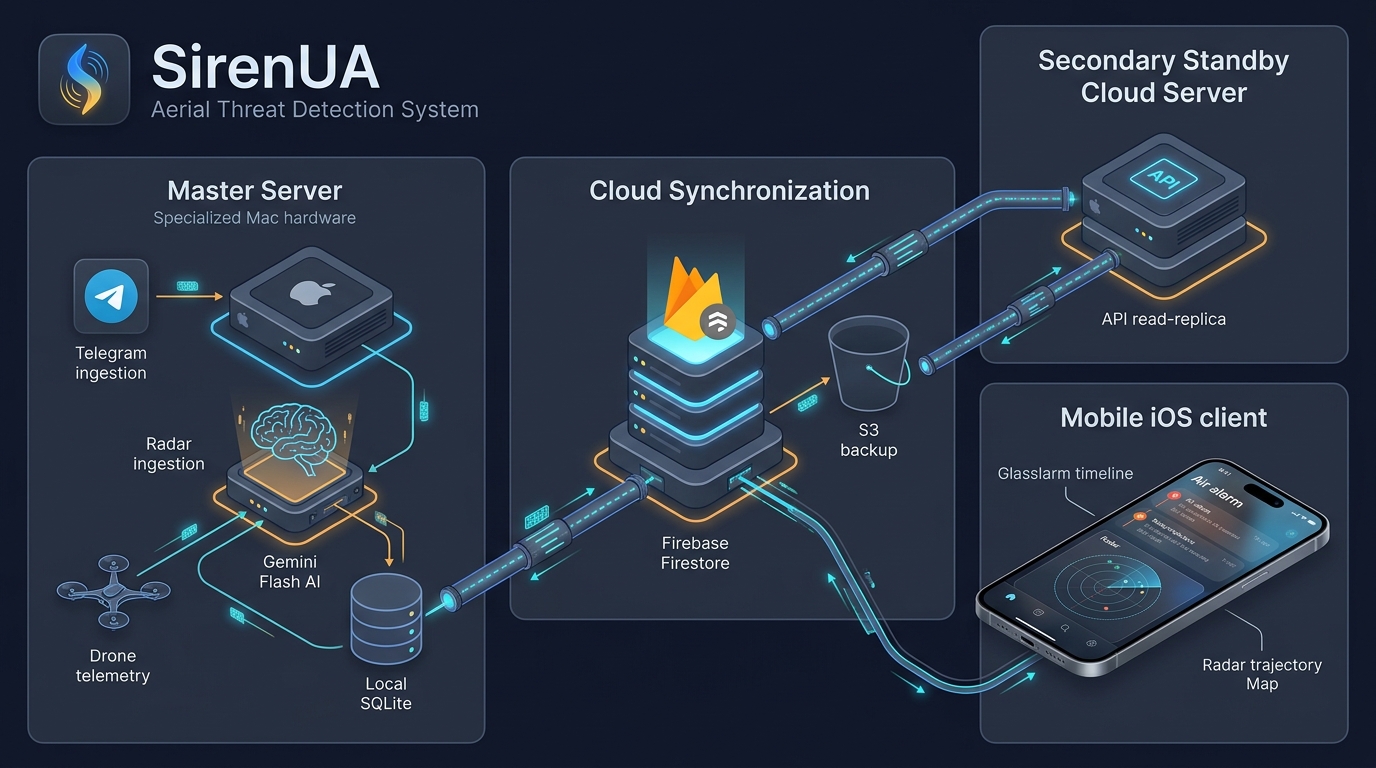
Defense-Grade Infrastructure Resilience: Engineered to the Zero-Data-Loss standard (RPO = 0s, RTO < 1.2s). SirenUA combines 5 layers of active state persistence β€” ranging from 15-minute cryptographic snapshots to event-driven WAL disk commits, geo-distributed cloud clusters, and local on-device iPhone edge caching.

πŸ“± Tier 5: On-Device Edge Offline Resilience

The SirenUA iOS client embeds an encrypted local SQLite database covering all 26 regional shelter networks and offline walking route math. Even during total cellular tower blackouts and internet loss, civilians instantly retain access to nearby Tier 1–4 bomb shelters, offline bearing compasses, and safety protocols.

Dual-Endpoint Client Failover

The iOS client maintains concurrent active connections via dual independent network transports: primary high-throughput static IP and encrypted edge proxy tunnel. Gateway switching executes seamlessly within 300 ms without interrupting emergency sirens.

RPO = 0s
Zero telemetry data loss under any failure
< 1.2s
Complete Disaster Recovery Time (RTO)
99.98%
Architecture Availability & Delivery SLA

Protect Yourself and Your Loved Ones

Download SirenUA for free on the Apple App Store.